
Risk Management
To ensure steady operation and sustainable development, the Risk Management Policy and Procedures were stipulated by the Board of Directors on February 27, 2020 based on the Regulations Governing Establishment of Internal Control Systems by Public Companies promulgated by the Financial Supervisory Commission. The Procedures stipulate the Board of Directors, Audit Committee, Auditing Office, President and President’s Office, individual risk management units, and subsidiaries shall together participate in, promote, and implement relevant risk management measures.
Risk Management Organization Structure and Risk Management Categories
The year 2020 witnessed the beginning of the status on risk management reported to the board of directors every year.
The 2025 status was reported to the board of directors on November 07, 2025, and the report details are tabulated as below.
Risk Management Status Report in 2025
The 2024 status was reported to the board of directors on November 8, 2024, and the report details are tabulated as below.
Risk Management Status Report in 2024
The 2023 status was reported to the board of directors on November 3, 2023, and the report details are tabulated as below.
Risk Management Status Report in 2023
The 2022 status was reported to the board of directors on November 4, 2022, and the report details are tabulated as below.
Risk Management Status Report in 2022
The 2021 status was reported to the board of directors on January 11, 2022, and the report details are tabulated as below.
Risk Management Status Report in 2021
The 2020 status was reported to the board of directors on January 22, 2021, and the report details are tabulated as below.
Risk Management Status Report in 2020
TIPS Implementation Status in 2025
Walsin Lihwa implemented the Taiwan Intellectual Property Right Management System (TIPS) to Yenshui plant and headquarter in 2020 and Hsinchuang plant is then joined in 2021. Walsin Lihwa continued to acquire the TIPS (level A) certification in 2023. To further enhance internal control of intellectual property management, in 2025, we integrated the group’s intellectual property information onto a single platform, presenting key figures in visualized charts for management level decision-making, and improving accessibility for intellectual property utilization, aiming to further perfect the scope of intellectual property management. The intellectual property right management policies and the targets are planned according to the TIPS regulation 5.2 and 5.3. The implementation status and annual plan are reported at a board meeting on November 7, 2025.
Intellectual Property Management Plan
-
- Intellectual Property Right Management Policies
- R&D for innovation and competitiveness enhancement,
- Employees’ awareness of intellectual property rights for more effective intellectual property right management.
- Confidential document management, and
- Execution corporate governance with compliance
※ The targets and implementation status according to the intellectual property right management policies, are listed in the “Annual implementation status and achievement ”section.
- Intellectual Property Right Management Policies
-
- Intellectual Property Management Measure
- Since the implementation of TIPS in 2020, Walsin Lihwa has continuously conducted sampling inventories of its patents, trademarks, copyrights, and trade secrets. Additionally, measures to encourage innovation, execute periodically IP training, improve IP management and contract review are taken with systematization and automation.
Management processes of IP risk assessment, proposal review of IP right application, IP right protection evaluation, Infringement handling procedure and attentions for the outsourcing of intellectual property affairs are regulated as intellectual property management measure. This year, we launched more meticulous and multi-layered optimization measures for intellectual property information management, integrating all group affiliates’ intellectual property data into a unified and efficient information management structure. We also planned and launched dedicated intellectual property management platforms tailored to the characteristics and needs of each business group. This not only systematizes the integration of all intellectual property-related reports, data, and information in the R&D process, improving the convenience of searching and utilization, but also uses data visualization technology to dynamically present key indicators in chart form, helping management level grasp the current status and trends of intellectual property utilization in real time, strengthening the accessibility and strategic use of intellectual property resources, and further promoting the continuous improvement and upgrading of the company’s intellectual property management scope.
In the future, Walsin Lihwa will review the intellectual property right management policies and adjust targets and intellectual property management regulations annually in accordance with operation strategy and the changes in government policy and market. Also, to ensure the management system operated effectively, Walsin Lihwa will review our intellectual property management and improve the management system through TIPS verification, in case of potential risk and IP related dispute.
Annual implementation status and achievement
-
- IP Management Targets and Implementation Status
No. IP Management Targets Implementation Status 1 Protection of internal R&D results: The company plans to file 7 new patent applications by the end of 2025 14 patent applications have been filed this year 2 Establish an industry-academia cooperation case management platform Basic platform construction completed, process setup and optimization ongoing 3 Report the implementation status of intellectual property management to the board at least once and update the annual implementation status of the intellectual property management system on the company website at least once Reported to the board on 11/7 and updated the annual implementation status on the company website on 11/21 4 Conduct at least one trade secret and confidentiality obligation training for all employees Training has been made available online via Walsin Academy 5 Inventory confidential documents at least once Annual confidential document inventory completed in Q3 6 Hold at least one intellectual property and TIPS system training for all employees Training has been made available online via Walsin Academy 7 Optimize IP Database Integrated group companies’ intellectual property data into the unified Walsin IP Database, and established a sub-platform (IP Database-Steel) for the stainless steel business group, further integrating FTO analysis reports and other information - Achievements of Intellectual Property acquisition
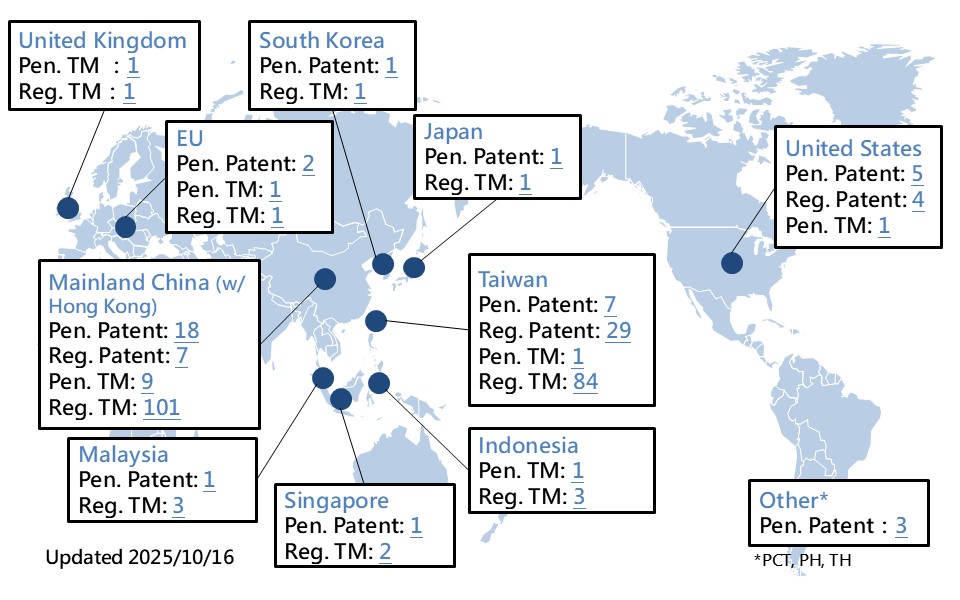
- This year, the company obtained 4 patents granted and filed 14 patent applications. As of October 16, 2025, the company holds 40 valid granted patents (27 invention, 8 utility model, 5 design), and has 39 pending applications (34 invention, 4 utility model, 1 design). There are 197 registered trademarks and 14 pending trademark applications. The overall intellectual property layout is shown in the following diagrams.
- Advantages and contribution of IP to cooperation operation
- Enhancement of IP protection: Continuing implementing IP knowledges to employees with IPR and Confidentiality related training session and providing assistance of suitable equipment and measures such as document leveling management to raising confidential awareness while executing works.
- Global operation layout: Aligning with the group internationalization strategy, integrating technology and brand layout, and achieving high-value products and services.
- R&D process improvement: Strengthen the R&D project-oriented R&D process and provide a reasonable reward system to increase the willingness of R&D employee for invention and patent application, so as to increase the company’s R&D and intellectual property capabilities.
- Corporate governance transparency: Disclose the implementation status of the intellectual property management plan on Walsin Lihwa official website to demonstrate the effectiveness of intellectual property management.
-
- TIPS verification
- In 2023, our company applied for and passed the Taiwan Intellectual Property Management System (TIPS) A-level re-certification, with the certificate valid until December 31, 2025. In 2025, we again applied for TIPS A-level re-certification and received the review result on November 10, 2025, with a recommendation for “approval.”
-
- Potential IP risk type and Countermeasures
- To ensure the R&D achievement and the corresponding rights are protected, preserve its economic values and prevent the IP right infringement, the IP risk type and countermeasures are listed below:
IP risk type Countermeasures Patent • Patent risk evaluation in R&D process
• Encourage R&D employee to propose patent applicationTrademark • Strengthen control power of trademark application, maintenance and usage Confidential information management • Strengthen and implement IP training for employee
• Improve confidential mark usage
• Attention for reviewing contract with external vendors
Prospects for Intellectual Property Management
Looking ahead, Walsin Lihwa regards the intellectual property management system as a core strategy for sustainable business operations, actively stimulating internal R&D and protecting technological achievements. By integrating Industry 4.0, we continuously optimize manufacturing processes, promote product innovation, upgrading, and smart manufacturing, and achieve high-value transformation. The company not only values effective intellectual property management but also closely integrates it with environmental sustainability, social responsibility, and corporate governance. Through transparent information disclosure, we strengthen trust with financial institutions, investors, and customers, enabling stakeholders to fully understand the company’s concrete actions in technological innovation, environmental protection, and social care. Walsin Lihwa is committed to energy conservation and carbon reduction, promoting green R&D, actively developing products and technologies that contribute to environmental sustainability, and aims for environmental friendliness and social contribution, implementing corporate governance and sustainable development, and ultimately achieving long-term stable growth and shared prosperity with society.
Walsin Lihwa’s dedicated information security team is committed to strengthening the overall information security protection capability of the enterprise, to enhance the enterprise’s information security rating, meet customers’ information security requirements, and fulfill the commitment to information security goals for customers, shareholders, and all stakeholders. To build a “digitally sustainable” information system architecture and advance the corporate goal of “digital transformation”, the Company has adopted “driving cloud-to-ground zero trust” and “strengthening cybersecurity resilience” as the principal pillars, established a comprehensive cybersecurity protection platform with simulation exercises, and integrated AI-driven proactive detection and prevention technologies to deploy real-time detection and defense capabilities.
In response to the increasingly severe cybersecurity threats, Walsin has implemented high-standard, in-depth cybersecurity defenses based on the NIST CSF and CISA ZTA frameworks, structured around six key processes:”Govern, Identify, Protect, Detect, Respond, and Recover” ; and five dimensions : “Identity, Endpoint, Network, Application, and Data” to comprehensively and effectively identify the information security risks faced by the enterprise and promptly apply effective control measures to mitigate information security risks.
Walsin will continue to optimize cybersecurity protection by introducing an integrated cloud and on-premises security management framework, gradually transitioning information systems and backup mechanisms to the cloud. This will enhance operational efficiency and the level of cybersecurity, supporting the realization of the “netzero carbon emissions” goal.
1. Risk management framework for information and communications security
Walsin Lihwa has promoted an information security strategy plan centered on “strengthening information security resilience” by establishing an overall information security protection platform, perfecting information security technical protection measures, demonstrating proactive defense capabilities, and laying the foundation for digital sustainability, in line with the government’s policy goal of “information security equals national security.” Walsin has established its information security risk management framework with a dedicated information security organization, senior executive participation, and alignment with international information security standards, specifying relevant information security policies and regulations to implement information security management.
- Dedicated Information Security Organization: In response to the corporate transformation and enhancement of information security management, Walsin Lihwa has established a dedicated information security organization – “Information Security and System Operation &Management Division” and, in 2022, appointed a Chief Information Security Officer (CISO), an information security manager, and two or more dedicated information security personnel. The division is responsible for formulating information security policies, planning, coordinating and implementing information security protection measures, continuously performing information security risk assessment and management, developing a complete information security plan, and promoting information security management and solutions year by year.
- Participation of Senor Executives: The Company has established the IT Steering Committee, which is the information security management and decision-making body for the head office and business units, and is responsible for reviewing and deciding on matters related to information security management. There are also several members on the Board of Directors with backgrounds in information security in the Audit Committee to supervise and review the promotion of information security policies.
- Implementation of Information Security Management: In 2022, Walsin Lihwa implemented ISO 27001 Information Security Management System (ISMS) and obtained certification from a third-party certification body to fully manage its information security through PDCA. In 2024, Walsin successfully obtained the new ISO 27001:2022 certification, further strengthening the security protection of threat intelligence, configuration management, and cloud services. We have built up the confidentiality, integrity, and availability of information security management system of our organizations comprehensively, and strengthened our information security management continuously through different management plans in such aspects as prevention beforehand, monitoring during the event, and response after the event.
2. Information Security Policies and Goals
The goal of information security at Walsin is to maintain the confidentiality, integrity and availability of sensitive information, such as customer data and business information. Therefore, all of our employees, internal and external information service users and third-party outsourced service providers should work together to follow and achieve the following policies and objectives:
- To protect the Company’s confidential information from being accessed, altered, or damaged in an unauthorized way or improperly disclosed, in compliance with internal and external regulatory requirements.
- To protect information on the Company’s business activities from unauthorized access or disclosure, and to ensure the accuracy of all business information.
- To establish a complete business continuity plan and information security incident management procedures, to ensure that incidents are responded to, controlled and handled properly, and by conducting regular drills, to ensure the continuous operation of information systems or services.
- To handle and protect personal information and intellectual property rights in a prudent manner in accordance with the relevant domestic and foreign regulations in respect of the Personal Information Protection Act and the intellectual property law.
- To perform regular information security compliance audits to review the implementation of the information security management system.
- All employees shall maintain a high level of information security awareness at all times, and supervisors at all levels shall assume ultimate responsibility for information security supervision, management and training, to achieve the goal of reducing the risk of information use through various activities, such as management review, risk assessment, internal audit, education and training, and information security drills.
- All staff of the Company shall follow information security policies, management practices and standard procedures, and violations of information security policies and related regulations shall be handled in accordance with relevant laws and regulations or the Company’s regulations.
3. Construction of the resilience of corporate information security and implementation of information security management
- We have drafted information security plan to promote information security policy year by year, to introduce information security system and process specification, and to continuously establish complete information security technical protection measures.
- The specific management plan is to be gradually achieved through the five stages of “Internal and External Segregation”, “Physical Fitness”, “Insight”, “Smart Security” and “Behavior Analysis”, the six phases of “Govern”, “Identify”, “Protect”, “Detect”, “Respond” and “Recover” and the five dimensions of “Identity”, “Endpoint”, “Network”, “Application”, and “Data” based on the cyber security control map established thereunder
- The specific management plans:
- Planning and establishing data protection mechanisms to reduce risk of leaking confidential information.
- Continuously introducing advanced information security solutions to effectively protect and manage system, host and network behavior.
- Strengthening external information service protection to enhance the ability to block hacker attacks.
- Regularly organizing educational training to promote new information security knowledge and to raise employees’ awareness of information security.
- Regularly conducting disaster preparedness drills for important systems, so that in the event of a disaster, operations may be quickly resumed to ensure the company’s operational sustainability.
- Improving the protection capability of endpoints, servers and network devices by introducing Endpoint Detection & Response (EDR).
- Introduction of information security monitoring mechanisms (Security Operations CenterSOC) to establish effective real-time incident handling and response capabilities.
- Walsin Lihwa introduced the ISO 27001 Information Security Management System (ISMS) in 2022 and obtained certification from a third-party verification institution, thereby implementing information security management with PDCA. We have comprehensively built the confidentiality, integrity, and availability of the organization’s information security management system, and according to different management planning in the aspects of prevention, monitoring, and response, in order to assist the enterprise in continuously strengthening information security management.
- Strengthening cloud information security management and achieving ESG digital sustainability purposes through ZeroTrust.
- Introducing M365 Security with AI automation technology to assist in cybersecurity detection and protection, targeting the Advanced level of zero trust.
- Introducing a Privileged Access Management (PAM) system to ensure the security of privileged account passwords.
- Introducing physical device security controls to ensure the data security of printing, copying, scanning, and faxing operations.
- Implement information security vulnerability analysis and proactively adopt protective measures to mitigate potential security risks.
- Establish the “Information Operations Outsourcing Management Regulations” and the “Walsin Lihwa Information Security Policy” to clearly define the information security requirements that outsourced service providers must comply with, and specify cybersecurity commitments and audit rights in contractual agreements.
4. Investment in cyber security management resources
The corresponding information security management issues and the resources to be invested are summarized as follows:
- Major issue: Since 2024, ‘Information Security Management’ has been included as one of the ‘Major Issues’ in the Company’s sustainability report.
- Dedicated organization: A dedicated information security organization, “Information Security and System Operation & Maintenance Division”, was established and a Chief Information Security Officer (CISO), an information security manager, and two or more dedicated information security personnel were appointed, responsible for drafting and amending information security policies, as well as planning, coordinating, and executing information security protection measures.
- Management review: The IT Steering Committee holds at least one management review meeting annually to audit the information security policy and its implementation and execution, in order to ensure the effectiveness and appropriateness of the standardized information security policy in compliance with relevant laws and the requirements of competent authorities.
- Information security certification: We pass the ISO27001 Information Security Management System (ISMS) certification annually, while there are no significant deficiencies in our related information security audits. As of the date of printing of this Annual Report, the validity period of the most recent certificate is from January 6, 2026 to January 6, 2029.”
- Stakeholder issues: In 2025, no major cyber security incidents or confidential information leakage occurred, nor did any other event cause losses to the Company and its customers.
- Advocacy and training: The Company continues promoting a month-long information security awareness campaign annually, as well as implementing mandatory information security education training courses for all employees. In 2025, the number of participants exceeded 2900. In 2025, 12 email social engineering drills were conducted, with more than 2900 participants, and colleagues who failed the social engineering drills were required to participate in online information security courses and complete the test. One cybersecurity incident reporting management drill was conducted.
- Information security regulations: In addition to revising all information security regulations in 2022, 3 regulations in 2023, 13 regulations in 2024, and 6 regulations in 2025 respectively, were further revised annually to comply with domestic and international legal requirements and respond to changes in the external environment.
- Information security testing: Four third-party information security risk testing operations were
conducted in 2025.
In 2025, no major cyber security incidents or confidential information leakage occurred, nor did any other event cause losses to the Company and its customers.
ISO 27001 Information Security Management System
Business Continuity Management Policy
The Procedures for Handling Material Inside Information and Prevention of Insider Trading of Walsin Lihwa are adopted to establish sound mechanisms for the handling and disclosure of material inside information to prevent improper information disclosures, ensure the consistency and accuracy of information released by the Company to the public, and prevent insider trading.
Moreover, to strengthen stock trading control measures, the Company may amend the Procedures for Handling Material Inside Information and Prevention of Insider Trading based on its Corporate Governance Best Practice Principle. The 2025 implementation status is tabulated as below.
| Period | Board Meeting Date and Public Announcement Date | Closed Period | Prevention Measures Implemented | Note |
|---|---|---|---|---|
| 2024 Annual Reports | 2025/2/25 | 2025/1/26-2025/2/25 |
Relevant insiders including but not limited to directors of the board emailed in advance by the Corporate Governance Director that they shall not purchase or sell, in their own names or in the name of any other person, shares of the Company that are listed on an exchange or an over-the-counter market, or any other equity-type security of the Company during the closed period. |
Also In compliance with Article 157-1 of the Securities and Exchange regarding prohibition of such purchasing or selling within 18 hours after public disclosure of material information. |
| 2025 Q1 Financial Reports | 2025/5/9 | 2025/4/24-2025/5/9 | ||
| 2025 Q2 Financial Reports | 2025/8/8 | 2025/7/24-2025/8/8 | ||
| 2025 Q3 Financial Reports | 2025/11/7 | 2025/10/23-2025/11/7 |
Walsin Lihwa has been promoting relevant laws and regulations against insider trading to its board of directors and executives above managers every year.
Implementation of Internal Promotion in 2023 (online and offline courses totaling 1 hours)
| Object | Course | Number of Attendees |
|---|---|---|
| All employees | Promotion of insider trading prevention | 2,590 |
| Directors of the board and managerial officers | Insider trading prevention: Relevant laws and regulations on material information and equity changes as well as other matters to note | 21 |
Supply Chain Policy
Walsin Lihwa has formulated the “Supplier Management Measures”, the “Supplier Social Responsibility Performance Appraisal Principles”, the “Sustainable Procurement Management Measures”, and the “Sustainable Raw Materials Policy” to ensure that suppliers meet requirements across quality, cost, delivery, and service dimensions, and to continuously monitor suppliers’ environmental protection and human rights practices through documented assessments and on-site audits , thereby fulfilling the Company’s corporate social responsibility and promoting the sustainable development of its supply chain.
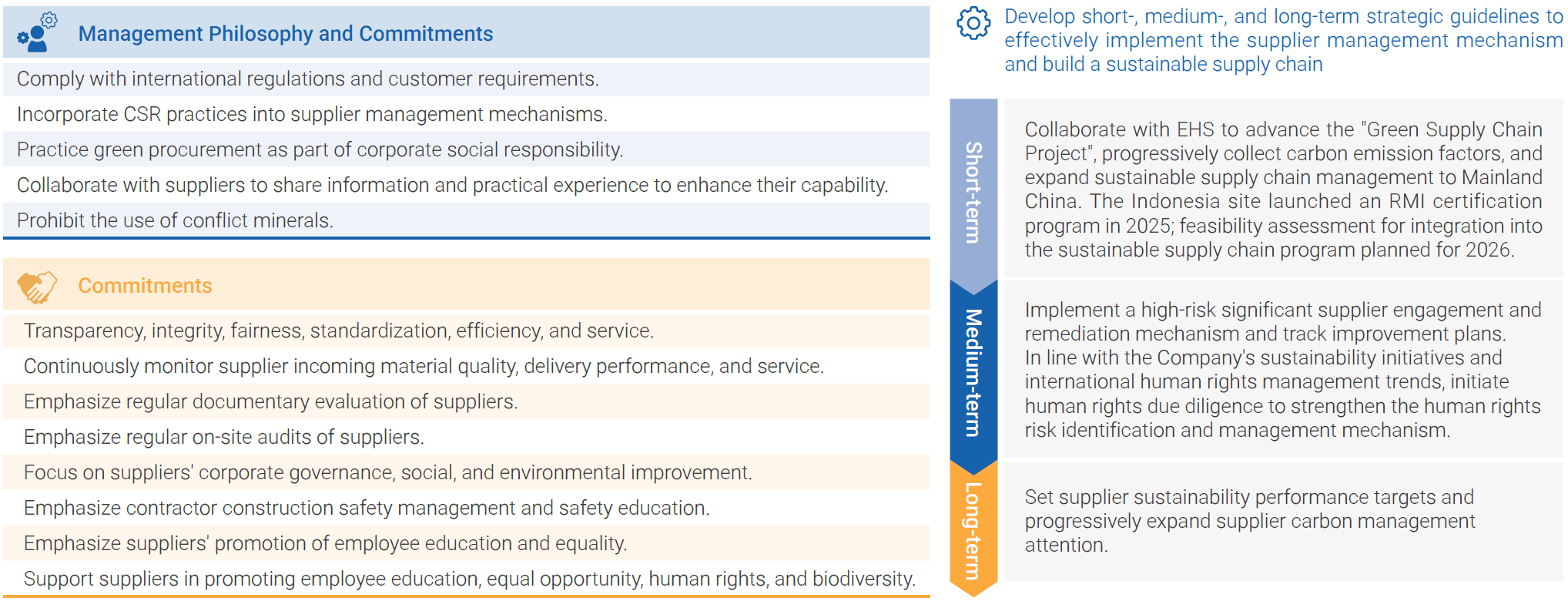
To effectively implement supplier management and build a sustainable supply chain, Walsin has established short-, medium-, and long-term targets. Through the exchange of information and operational practices, we continuously communicate our sustainable management policies to suppliers , foster a resilient supply chain, and advance toward shared values and goals.
Identification of Significant Suppliers
Walsin Lihwa uses critical raw materials, indirect materials, capital equipment, engineering contracting, waste disposal, and outsourced manufacturing as screening factors, applying the “Supplier Management Measures” and the “Supplier Social Responsibility Performance Appraisal Principles to identify significant suppliers based on procurement value, sustainability governance capability, country/industry/commodity risk, and business relevance, including considerations such as significance, influence, uniqueness, and strategic partnership. From a total supply base of 4,140 suppliers Note 1 , 148 significant suppliers Note 2, 3 , were identified, representing 62.33% of total procurement spend. These suppliers are the counterparts with whom the Company jointly advances supply chain resilience and strengthens supplier corporate social responsibility.
Note 1: Suppliers refers to Tier-1 suppliers, i.e., suppliers that transact directly with Walsin Lihwa; defined as suppliers registered, paid and managed through the procurement process with a goods-receipt record in the year, excluding consolidated related parties and duplicates across plants.
Note 2: Includes the Taipei head office, the Wire and Cable Business (Hsinchuang Plant, Yangmei Plant, Shanghai Walsin, Hangzhou Walsin), the Stainless Steel Business (Yenshui Plant, Taichung Plant, Yantai Walsin, Changshu Walsin, Jiangyin Walsin), Walsin Precision and Nanjing Walsin (Real Estate). Including the European stainless steel suppliers, the total number of suppliers is 6,917, from which 593 significant suppliers were identified, accounting for 64.98% of total procurement value.
Note 3: The significant suppliers identified are the subjects of the 2026 risk identification exercise.
Implementation of Supply Chain Management
Supplier’s Undertaking
Sustainable Raw Materials Policy
Prohibited Use of Conflict Minerals
To enforce the policy of prohibiting the use of conflict minerals, we require suppliers to voluntarily disclose the sources of their minerals, to ensure that their procurement does not originate from conflict-affected or high-risk areas and complies with customer and regulatory requirements. And the priority is given to sourcing from qualified facilities validated by the Responsible Minerals Initiative (RMI), or due diligence is conducted using RMI’s reporting templates—the Conflict Minerals Reporting Template (CMRT), the Extended Minerals Reporting Template (EMRT), and the Additional Minerals Reporting Template (AMRT), to eliminate the possibility of using conflict minerals.
If you have any questions regarding our policy of prohibiting the use of conflict minerals, please contact: opinion@walsin.com
RMI Facilities Lists:https://www.responsiblemineralsinitiative.org/facilities-lists/
CMRT:https://www.responsiblemineralsinitiative.org/reporting-templates/cmrt/
EMRT:https://www.responsiblemineralsinitiative.org/reporting-templates/emrt/
AMRT:https://www.responsiblemineralsinitiative.org/reporting-templates/amrt/
Suppliers’ Commitment to Sustainability and Self-Assessment
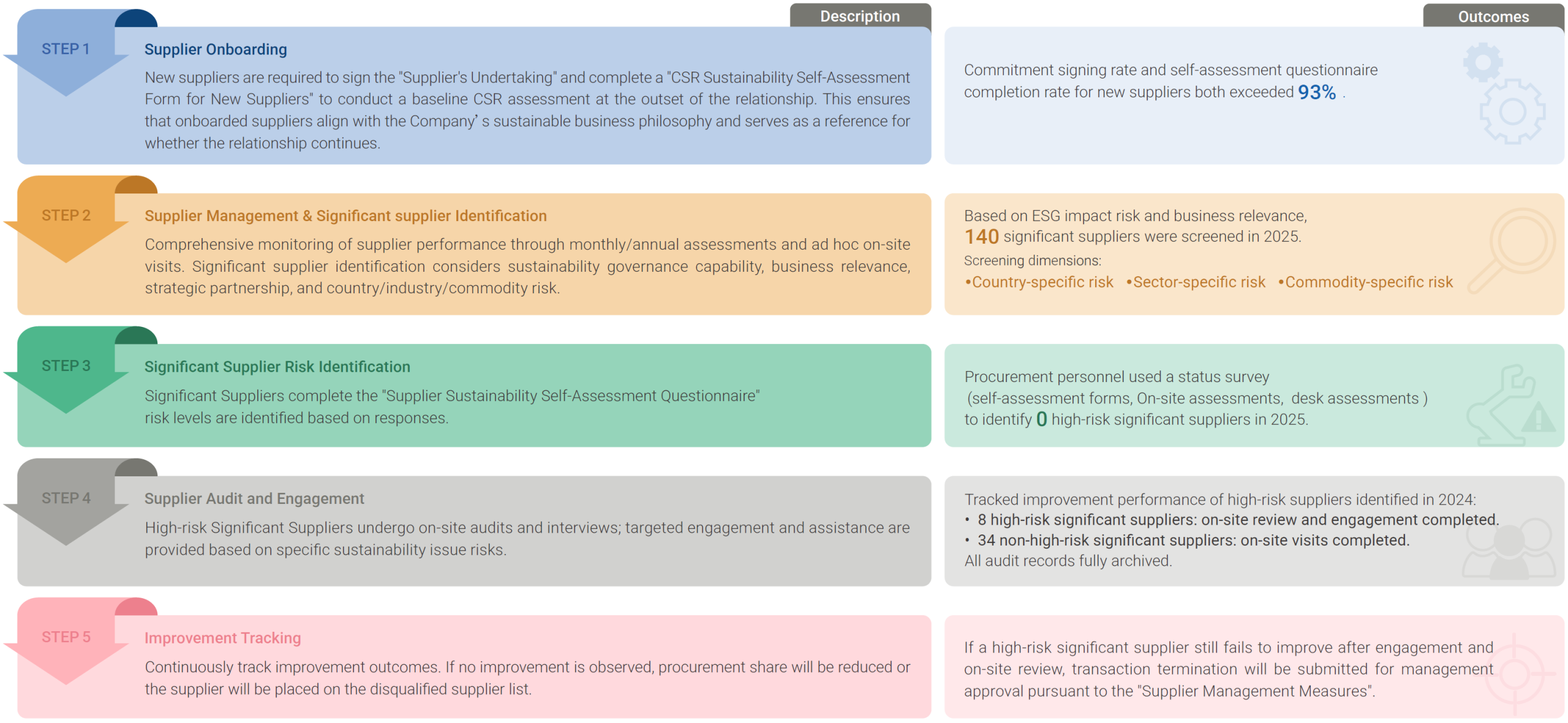
To strengthen and implement sustainable supplier management, suppliers of the Taiwan and Mainland China plants are required to sign the “Supplier’s Undertaking” to ensure compliance with the Company’s relevant management requirements. And suppliers would complete the “Supplier CSR Self-Assessment Questionnaire” evaluating their own management practices across economic, social, and environmental dimensions. Based on the responses, the Company analyzes each supplier’s level of sustainability management and evaluates the likelihood, severity, and early-warning mechanisms of potential sustainability threat events, thereby identifying the degree of threat and impact each significant supplier could pose to Walsin Lihwa’s operations should such an event occur.
And based on the evaluation results, we will prioritize trading with suppliers that demonstrate superior ESG performance. However, if a supplier is classified as a “High-Risk Supplier,” we will conduct on-site audits and guidance in cooperation with our Environmental, Health, and Safety (EHS) department in the following year. Such suppliers will be required to rectify deficiencies within a specified timeframe to meet the minimum ESG requirements. Failure to improve will lead to a gradual reduction in procurement proportions or classification as an unqualified supplier, depending on the severity of the situation. Once listed as an unqualified supplier, they will be disqualified from signing subsequent contracts and conducting transactions.
For more information, please visit the sustainability website: https://esg.walsin.com/en
WalsinLihwaCorporation attaches great importance to the rights and interests of customers, consumers, employees, suppliers, shareholders,human rights, and all other parties engaging with the Company. Throughout its operations, the Company complies with applicable laws and follows internal management regulations to safeguard stakeholder rights in areas such as product health and safety, advertising and labeling, supplier management, personal data protection, and complaint handling. Through clear communication and grievance channels, the Company ensures that stakeholders receive timely responses and appropriate protection.
Unified Complaint and Contact Channel
The Company has established a unified contact and complaint mailbox: opinion@walsin.com, which is used for Personal Data–related complaints as well as consumer and client feedback. All submissions are accepted, investigated, responded to, and recorded in accordance with the Company’s established procedures and applicable regulations.
Personal Data Protection
The Company collects, processes, and uses Personal Data in accordance with applicable laws and its Personal Data Protection Management Regulation, and adopts necessary administrative and security measures to safeguard the rights of Data Subjects.
-
- Scope of Application
This mechanism applies to the Company and its subsidiaries, branches, and plants; all employees and temporary personnel; customers, investors, shareholders, vendors engaging with the Company; and organizations or individuals entrusting the Company to process Personal Data. - Responsible Units
Corporate Governance, Human Resources, Information Technology, and Audit Units carry out Personal Data management according to their responsibilities, including system planning, data maintenance, information security protection, and audit tracking. - Personal Data Management and Protection Measures
The Company conducts Personal Data inventory, access control, data retention and maintenance, and information security protection in accordance with laws and internal regulations, and provides required notifications to Data Subjects before data use. - Rights of Data Subjects
Data Subjects may request inquiry, access, duplication, supplementation or correction, cessation of use, or deletion of their Personal Data. The Company will process such requests in accordance with established procedures. - Personal Data Incident Handling
The Company maintains reporting and response mechanisms for Personal Data incidents. In the event of unauthorized access, leakage, or other abnormalities, relevant units shall promptly investigate, report, and take necessary actions in accordance with procedure. - Personal Data Education and Training
The Company conducts regular Personal Data protection training and maintains relevant records.
2025 Training Outcomes
Indicator Result Number of participants 812 persons Total training hours 364.7 hours Completion rate 100% - Scope of Application
Consumer and Client Rights Protection
The Company adheres to the Corporate Consumer and Client Service Management Policy and Complaint Handling Procedures to protect the rights of consumers and clients, including product health and safety, the accuracy of marketing and labeling information, supplier management requirements, and the protection of customer and consumer Personal Data.
-
- Product Health and Safety
The Company complies with health and safety requirements in product design, manufacturing, packaging, transportation, and sales. When products may pose health or safety risks, the Company will provide notifications or execute recalls in accordance with competent authority regulations. - Advertising, Marketing, and Labeling
Marketing, advertising, and product labeling must be truthful, clear, and compliant with relevant laws. The Company follows internal review procedures and legal requirements before publication. - Supplier Management
During supplier selection, the Company performs reviews in accordance with internal guidelines and requires suppliers to comply with applicable standards and commitments to ensure responsible and high-quality cooperation. - Protection of Client and Consumer Personal Data
The Company manages customer and consumer Personal Data in accordance with its Personal Data Protection Management Regulation, applying the same standards used for Company Personal Data protection. - Complaint Handling Process
Upon receiving inquiries or complaints from consumers or clients, the Company conducts acceptance, investigation, handling, and response in accordance with established procedures and applicable laws, ensuring fairness and objectivity. The identity and Personal Data of complainants shall not be disclosed without consent.
If an investigation confirms a violation or suspected illegal act, the case will be referred to the relevant units for disciplinary action or legal accountability in accordance with applicable regulations.
All complaint records—including acceptance, investigation, and results—must be maintained in written or electronic form for five years. If litigation or arbitration arises during the retention period, the records shall be preserved until the conclusion of legal proceedings.
Complaint cases are handled as confidential files and managed as dedicated cases. The Audit Unit supervises relevant departments to ensure timely corrective actions and will provide a response or progress update within 30 days of receipt.
FILE:
Walsin Personal Data Protection Management Regulation
Corporate Consumer and Client Service Management Policy and Complaint Handling Procedures - Product Health and Safety